

Every year, upwards of twenty lakh students sit for NEET, chasing a number of MBBS and BDS seats that hasn't grown anywhere near as fast as the applicant pool. That math alone should tell you something: hoping your preparation is "good enough" isn't a strategy, it's a gamble. And nowhere does that gamble get exposed faster than in Chemistry — the section students are most likely to either quietly ace or quietly bleed marks in, often without realizing which one is happening until results day.
That's exactly why so many serious aspirants and their parents go looking for satyakam sir neet chemistry results before committing to a coaching decision. It isn't blind brand loyalty. It's the simple observation that some students walk out of his batches converting Chemistry from their weakest section into their most reliable one — and that kind of consistent shift doesn't happen by accident. It happens because of a specific, repeatable method, run by a chemistry teacher with best neet results tracked openly across multiple attempts rather than quoted selectively.
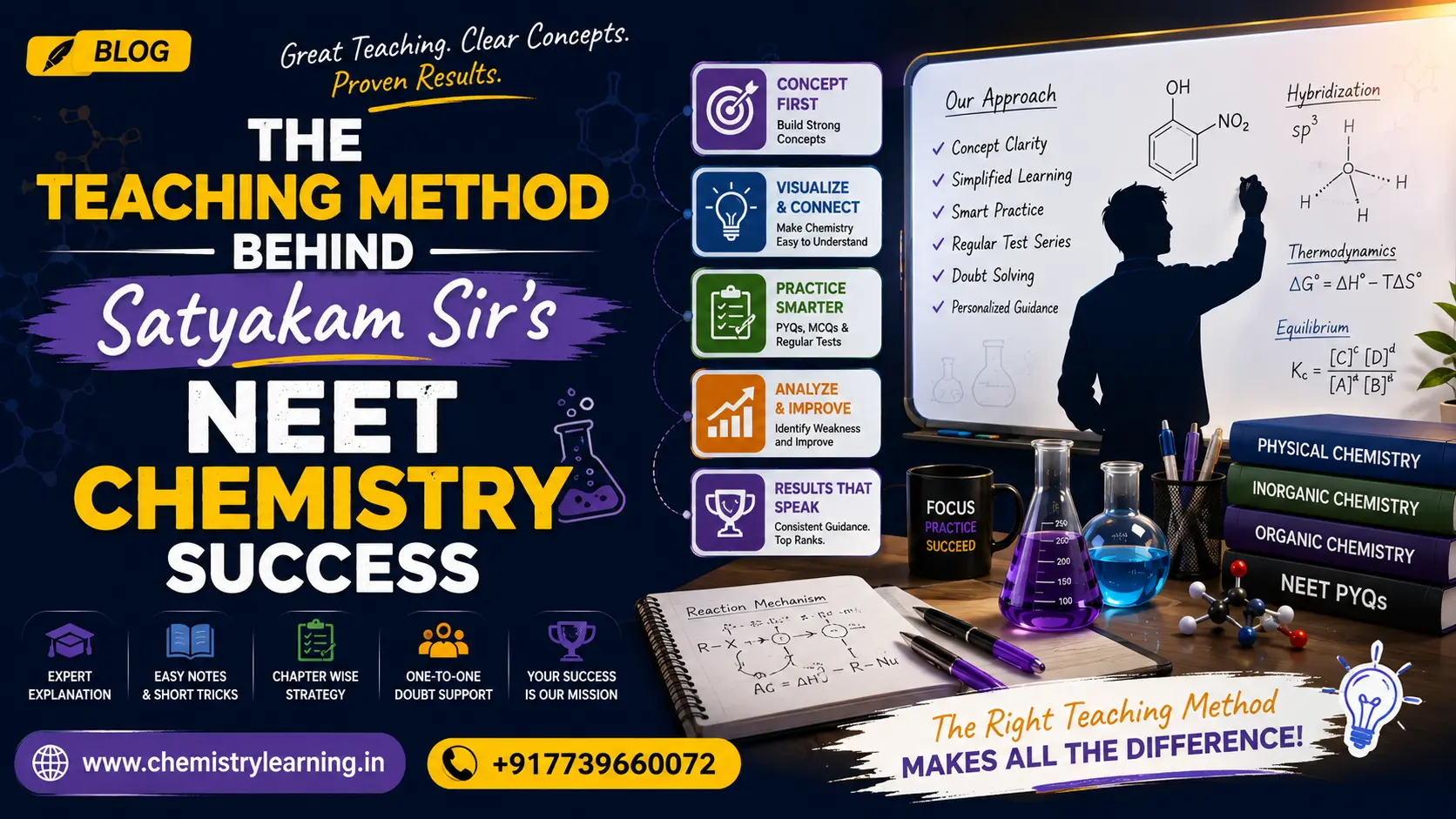
This article breaks down exactly what that method is. Not testimonials, not vague promises — the actual teaching mechanics behind the teaching method behind satyakam sir's neet chemistry success, so you can judge for yourself whether it fits how you learn, and borrow whatever parts of it you can even if you end up preparing elsewhere.
One thing worth saying upfront: this isn't a claim that Chemistry can be "cracked" through some secret shortcut. It's closer to the opposite. The method described here works precisely because it removes shortcuts — the memorized shortcuts that feel productive in October and quietly fall apart in the exam hall the following May. What replaces them is slower to build but far harder to forget, which is exactly the trade-off a serious NEET aspirant should want to make.
Why NEET Chemistry Decides More Than Students Expect
Biology carries the most weight on the NEET marks sheet, and Physics has a reputation for being the toughest to crack under time pressure. Chemistry sits in between — and that middle position is exactly what makes it so valuable. It's less conceptually punishing than Physics, but far less forgiving of guesswork than students assume, because NEET Chemistry questions are frequently NCERT lines rephrased just enough to trip up anyone who only skimmed the textbook once.
Here's the part that matters most: Chemistry is the section where a well-taught student can pick up marks fastest, because so much of it rewards precise recall of well-understood material rather than the kind of multi-step problem-solving Physics demands. A top chemistry teacher for neet understands this and treats Chemistry as the section where a student's overall rank gets quietly decided — not Biology, which most students already study hard, and not Physics, which most students already fear enough to over-prepare for.
The Problem With One-Size-Fits-All NEET Batches
Walk into most large NEET coaching centers and the pattern repeats itself with almost mechanical precision: a packed hall, a instructor working against a fixed syllabus calendar, and a teaching style built for the average student in the room rather than the actual student sitting in any particular seat. When a genuinely conceptual topic like Chemical Bonding or Equilibrium comes up, there's rarely enough time to slow down for the twenty percent of the room that's still confused — the batch moves on regardless.
The result is predictable. Students walk away with notes full of facts they can recognize but not fully explain. That's fine right up until NEET asks an assertion-reason question that requires actually understanding both statements independently, not just recalling that they sound familiar. A chemistry faculty for neet operating at scale, without a system for catching individual gaps, will always produce a spread of outcomes — some students thrive despite the system, most just get by, and a meaningful number quietly fall behind without anyone noticing until a mock test score reveals it.
A chemistry teacher for concept clarity spends the extra ten minutes most crowded batches simply don't have.
Inside Satyakam Sir's Chemistry Teaching Method for NEET
Satyakam sir chemistry teaching method starts from a simple, non-negotiable rule: no fact gets taught without its reasoning attached. This is what separates concept based chemistry teaching from the usual formula-and-example routine — a student isn't just told that something is true, they're walked through why it has to be true, so the same logic can be reapplied to a question phrased in a way they've never seen before.
This philosophy plays out differently across the three branches of Chemistry, because NEET tests each one differently. Physical Chemistry rewards fast, accurate numericals. Organic Chemistry rewards genuine mechanistic understanding. Inorganic Chemistry rewards an almost forensic familiarity with the NCERT text itself. A single teaching style stretched across all three will always underperform in at least one of them — which is exactly why the chemistry teaching methodology for neet used here treats each branch as its own discipline.
There's also a practical layer underneath all of this: not every chapter carries equal weight on the actual exam. Coordination Compounds, Chemical Bonding, p-Block Elements, and General Organic Chemistry have historically been dense with questions year after year, and a mentor who's tracked that pattern across multiple attempts can guide a student's time toward the chapters that move the score fastest — without ever suggesting that the lower-weightage chapters can simply be skipped. Prioritization isn't the same as neglect; it's about sequencing effort so the highest-yield topics get the deepest treatment first, while everything else still gets covered properly before the exam. It's this kind of sequencing, built into the chemistry classes for neet preparation structure from day one, that tends to separate a well-planned attempt from a rushed one.
Physical Chemistry Preparation for NEET
NEET's Physical Chemistry questions are rarely as layered as JEE's, but that doesn't make them easy — it makes them fast-paced and unforgiving of formula confusion. A student who has to pause and recall which version of an equation applies has already lost the time advantage this section is supposed to give them.
What This Phase Focuses On:
- Deriving formulas from first principles instead of memorizing final forms.
- Building instant recall of standard values and units through repetition, not cramming.
- Timed numerical drills that mirror actual NEET time pressure.
- Build from the derivation, every time. Whether it's Mole Concept, Thermodynamics, or Electrochemistry, the formula is derived on the board before it's ever used in a problem — so a slightly reworded NEET question doesn't catch a student off guard.
- Train recognition speed. NEET rewards students who can identify the correct approach within seconds. Regular short numerical sets are used specifically to build that instinct, not just to "practice more."
- Remove the guesswork from units. Just like in JEE prep, unit tracking is taught as a built-in error check — a habit that quietly prevents a large share of avoidable NEET mistakes.
Why It Works
Under exam pressure, memorized formulas are the first thing to blur. A derived formula, on the other hand, can be rebuilt from scratch in seconds if memory falters — which is exactly the safety net a 45-question, time-boxed Chemistry section demands.
Organic Chemistry Preparation for NEET
Organic Chemistry in NEET leans heavily on reaction identification and mechanism-based reasoning, particularly in biomolecules, polymers, and everyday chemistry chapters that link directly to the Biology syllabus. Students who memorize reactions in isolation struggle the moment a question links two chapters together.
What This Phase Focuses On:
- A rock-solid foundation in General Organic Chemistry before any named reaction is introduced.
- Visual, electron-flow-based teaching of reaction mechanisms.
- Direct linking of Organic Chemistry chapters to their real-world and Biology-adjacent relevance, which NEET frequently tests.
- GOC first, always. Inductive effect, resonance, and hyperconjugation are taught to mastery before students move into reaction-heavy chapters, because skipping this step is the single biggest reason Organic Chemistry feels random to students later.
- Teach the mechanism, not the memory trick. Instead of asking students to remember a reaction outcome, we walk through how the electrons actually move — which means an unfamiliar reagent stops being a reason to panic.
- Connect chapters on purpose. Biomolecules, polymers, and chemistry in everyday life are explicitly linked back to core Organic principles, so they stop feeling like disconnected "extra" chapters to be crammed separately.
Why It Works
NEET's Organic questions often test whether a student understands a concept well enough to apply it in a new context — a biomolecule question dressed up to look unfamiliar. Mechanistic understanding transfers across contexts. Memorized facts don't.
Inorganic Chemistry Preparation for NEET
If there's one section where NEET rewards discipline over brilliance, it's Inorganic Chemistry. The syllabus is dense, but almost entirely NCERT-bound — which means the ceiling here is genuinely within reach for any student willing to read the textbook properly, more than once.
What This Phase Focuses On:
- Word-for-word familiarity with NCERT lines, tables, and footnotes.
- Understanding periodic trends through the physics behind them, not as memorized lists.
- Structured, spaced revision instead of one large cramming push before the exam.
- The NCERT is the syllabus. No external reference gets priority over the exact wording of the NCERT textbook, because that's overwhelmingly where NEET's Inorganic questions are sourced from, including the small print.
- Explain the exceptions. Anomalies like unusual ionization trends or unexpected oxidation states are taught through shielding and effective nuclear charge, not memorized as arbitrary quirks.
- Revise on a schedule, not a panic. Inorganic Chemistry decays fast if it isn't revisited regularly, so it's built into a recurring revision cycle from early on rather than left for the final month.
Why It Works
Random facts fade from memory quickly; facts attached to a clear reason don't. Once a student understands why an exception exists, it stops needing to be "remembered" at all — it becomes something they can reconstruct on the spot.
How to Score 160+ in NEET Chemistry
Ask any high scorer how they cracked Chemistry, and the answer is rarely "I studied more." It's almost always some version of "I stopped losing marks on things I actually knew." Here's what that looks like as an actual, executable strategy rather than a vague goal.
The Working Benchmarks
- Accuracy over ambition: Attempting all 45 questions means nothing if guesswork is dragging your score down through negative marking. A steady 90%+ accuracy on attempted questions matters more than attempting every single one.
- NCERT line recall, not NCERT familiarity: "I've read this chapter" and "I could recreate this table from memory" are two very different states — only the second one survives an assertion-reason question.
- Numerical speed under 60 seconds: Physical Chemistry questions should rarely take longer than a minute if the underlying formula has actually been internalized rather than half-remembered.
- Zero blind guesses in Organic mechanisms: A guessed mechanism question is a coin flip with a penalty attached — genuine understanding removes the guess entirely.
None of these benchmarks are about talent. They're about discipline, repetition, and a chemistry preparation strategy by expert teacher guidance that catches the gap between "familiar" and "exam-ready" well before results day makes the difference painfully clear.
Attempt order matters more than most students realize, too. A common and effective approach is to start with Inorganic Chemistry questions first — they're typically the fastest to answer when preparation is solid, and banking those marks early builds the confidence and time cushion needed for the numerical-heavy Physical Chemistry questions that follow. Organic Chemistry, with its mix of quick recognition questions and slower mechanism-based ones, usually works best last, once the section's rhythm is already established and panic isn't a factor.
Chemistry Roadmap for NEET 2026 and NEET 2027
Not every aspirant is starting from the same point on the calendar, and pretending otherwise is one of the most common planning mistakes students make. A chemistry roadmap for neet 2026 has to be revision-heavy and ruthless about prioritization, because there simply isn't runway left to build every concept slowly from zero. A chemistry roadmap for neet 2027 has the luxury of time — which should be spent building depth early, not delaying it.
Where students go wrong is trying to import one roadmap onto the other. A 2027 aspirant rushing through Foundation to "get ahead" usually ends up with the same shallow understanding a rushed 2026 aspirant has no choice but to accept — except the 2027 student had time to avoid it and didn't use it. The stages below stay identical either way; what changes is strictly how long each one gets.
Class 11-level concepts built slowly, with heavy emphasis on GOC, Mole Concept, and Atomic Structure — the load-bearing chapters everything else depends on.
Class 12 chapters layered on top, with continuous, deliberate linking back to Class 11 concepts instead of treating them as separate blocks.
Full-syllabus revision cycles begin, with Inorganic Chemistry on a repeating schedule and weak chapters flagged through regular chapter-wise testing.
Full-length mock tests under real time constraints, with every wrong answer reviewed for whether it was a concept gap, a silly error, or a time-pressure mistake.
The stages don't change between 2026 and 2027 aspirants — only the pace does. A 2027 aspirant might spend six unhurried months in the Foundation stage. A 2026 aspirant compresses that same stage significantly and shifts into Consolidation far sooner, because the exam clock simply won't wait.
A Revision Strategy That Actually Sticks
Most students revise by re-reading, and most students are quietly frustrated by how little that seems to help closer to the exam. A real chemistry revision strategy for neet looks completely different — it's built around active recall, not passive review. That means closing the notes and trying to write out a concept from memory before checking what was missed, rather than simply running your eyes over the same paragraph a fourth time.
Spaced repetition matters just as much, particularly for Inorganic Chemistry, where facts decay quickly without regular contact. A chapter revised once a month, in short, focused bursts, sticks far better than the same chapter reread twice in one long session right before the exam.
Mistakes That Quietly Cap a Chemistry Score
Most NEET aspirants aren't underprepared in the way they think they are. The effort is usually there. What's missing is an awareness of which habits are actually working against them, often in ways that don't show up until a mock test score refuses to move.
The first is confusing familiarity with mastery. A chapter read four times feels thoroughly covered, but recognition isn't recall — being able to nod along to a fact is very different from being able to reconstruct it cold, without the textbook open in front of you. NEET's assertion-reason format is specifically designed to expose this gap, because it demands independent judgment on two separate statements rather than pattern-matching against something half-remembered.
The second is treating Organic Chemistry as a memory exercise instead of a logic one. Trying to memorize outcomes for dozens of reactions independently, rather than understanding the handful of mechanisms that generate all of them, is a slow-motion trap — it works fine for the first few chapters and then collapses under its own weight once the syllabus gets denser.
The third, and possibly the most common, is under-investing in Inorganic Chemistry until the final weeks. Because it doesn't feel intellectually demanding in the way Physical Chemistry numericals do, it's easy to keep pushing it down the priority list — right up until a student realizes, uncomfortably close to the exam, just how much ground actually needs covering.
A Two-Minute Gut-Check
- Pick a chapter you "finished" over a month ago. Try writing its key points from memory before checking your notes.
- If Organic Chemistry questions outside your practiced examples feel intimidating, that's a mechanism gap, not a memory gap.
- If your Inorganic Chemistry revision hasn't happened in three weeks, it's already started fading — regardless of how well you knew it originally.
Why Mock Test Strategy Decides the Final Push
By the time a student is a few months out from NEET, content revision alone stops moving the score much. What actually moves it is a disciplined chemistry mock test strategy for neet — not just taking test after test, but reviewing every single wrong or guessed answer closely enough to categorize it. Was it a genuine concept gap? A silly, avoidable slip? A time-pressure decision made in the last thirty seconds of the section?
Each category demands a different fix. Concept gaps send a student back to that specific topic. Silly errors demand slower, more careful reading of the question stem. Time-pressure mistakes mean the pacing strategy itself needs adjusting. Skipping this review step and simply moving on to the next mock test is, honestly, one of the most common ways students plateau in the final stretch.
Built to Be Personal, Not Generic
None of the above works particularly well if it's delivered the exact same way to every student in a room of two hundred. That's why personalized chemistry coaching for neet is treated as a structural requirement here, not a marketing add-on. Regular chapter-wise testing exists specifically to flag individual weak spots early, while there's still time to fix them — not months later, when a mock test score delivers the same information too late to act on.
In practice, that means doubt sessions built around actual student questions rather than a generic FAQ list, and a weekly review cycle where recent test performance directly shapes what gets revised next. If three students are stuck on the same Equilibrium numerical, that's treated as a signal to re-teach the concept differently for the whole batch — not just to hand out the answer and move on. That feedback loop is quietly one of the biggest differences between coaching that talks about personalization and coaching that's actually structured around it.
It's also why best online chemistry teacher for neet searches increasingly lead students here instead of to a local institute. A recorded lecture that can be paused, rewound, and revisited during the final revision months does something a live-only classroom simply can't — it puts the pace of learning back in the student's hands. Combined with a responsive doubt-resolution system, this becomes a genuine chemistry mentor for neet aspirants relationship, not a one-way broadcast.
A Direct Message from Satyakam Sir
"I've had students walk in convinced Chemistry was their weakest subject, purely because nobody had explained the 'why' behind it clearly enough. That's the entire method — explain the reasoning, test it relentlessly, and let the marks follow. I've been fortunate enough to be called a chemistry teacher recommended by toppers more than once, and every single time, the actual reason was the same: we didn't let them get away with memorizing."
Give Your NEET Chemistry a Real Method, Not Just More Hours
More revision hours don't fix a shaky foundation. A structured, concept-first chemistry coaching for neet plan does — with a chemistry tutor for neet who treats every doubt as something worth solving properly, not just quickly. If you're ready to stop guessing and start scoring, this is the point where that shift actually begins.
Join Satyakam Sir's NEET Chemistry ProgramFrequently Asked Questions

About Satyakam Sir
Satyakam Sir has spent over fifteen years teaching chemistry to competitive exam aspirants, with a teaching philosophy built entirely around explaining the reasoning behind a concept before ever asking a student to apply it. Increasingly named among the top chemistry mentor in india for neet searches, he currently mentors NEET aspirants through a structured, concept-first online chemistry program.