

Every JEE Mains session, well over a million students compete for a number of NIT, IIIT, and GFTI seats nowhere near large enough to match that applicant pool. Against numbers like that, hoping your preparation is "probably good enough" isn't a strategy — it's a gamble most students don't realize they're making until their percentile lands lower than expected. And nowhere does that gamble get exposed faster than in Chemistry, the section students are most likely to either quietly master or quietly lose marks in, without noticing which one is happening until it's too late to fix.
That's exactly why so many serious aspirants and their parents go searching for the best chemistry teacher for jee mains 2027 well before the exam calendar even feels urgent. It isn't blind brand loyalty or marketing noise. It's the simple observation that some students walk out of the right classroom converting Chemistry from their slowest, most error-prone section into their fastest, most reliable one — and that kind of consistent shift doesn't happen by accident. It happens because of a specific, repeatable teaching method, not a slogan on a banner.
The market for JEE coaching is loud. Every institute claims to have the top chemistry teacher for jee mains 2027 on staff, and every city has at least one billboard promising guaranteed percentiles. But there's a real, measurable gap between a teacher who can get a student through a school-level chapter test and a mentor who can help them shave forty seconds off every numerical without sacrificing accuracy. You don't need another lecturer reading off a slide. You need someone who has spent years figuring out exactly where JEE Mains aspirants lose time and marks — and who has built a system to stop it from happening to you.
This article breaks apart the myth of the "good enough" JEE batch and lays out, step by step, exactly how Satyakam Sir — recognised by students across the country as the best chemistry teacher for jee mains preparation — actually builds that speed and clarity in a student's mind. No vague promises. Just the real mechanics behind best chemistry teacher for jee mains 2027 in india searches consistently leading back to a concept-first, NCERT-anchored, speed-trained method.
Why JEE Mains Chemistry Rewards Speed and Precision
Mathematics is designed to exhaust you. Physics is designed to challenge your visualization under time pressure. Chemistry, taught the right way, is explicitly designed to save you — and this is truer for JEE Mains than almost anywhere else in the JEE ecosystem. Mains is a large, time-boxed paper with a huge volume of questions, and Chemistry is disproportionately the section where a well-prepared student can move fastest, because so much of it rewards precise recall of well-understood material rather than the kind of multi-step problem-solving Physics demands.
An expert chemistry teacher for jee mains 2027 understands this and treats Chemistry as the section where percentile gains happen fastest per hour invested. It's also the section most vulnerable to being under-prepared, precisely because it can feel deceptively manageable — until a shifted variable or an unfamiliar NCERT line exposes a gap that was papered over with memorization instead of genuine understanding.
There's a compounding effect here that's easy to underestimate. A student who locks in a genuinely fast, reliable Chemistry section buys real breathing room elsewhere on the paper — extra minutes for a stubborn Physics numerical, or a calmer, more careful pass through Mathematics. That's the quiet, structural reason experienced mentors keep steering serious JEE Mains 2027 aspirants toward treating Chemistry as a priority section, not the one they'll "get to" after Physics and Math feel comfortable.
The Problem With Generic JEE Batches
Walk into most large commercial coaching institutes in India and the pattern repeats itself with almost mechanical precision: a packed hall, an instructor working against a fixed syllabus calendar, and a teaching style built for the average student in the room rather than the actual student sitting in any particular seat. When a genuinely conceptual topic like Chemical Equilibrium or Electrophilic Aromatic Substitution comes up, there's rarely enough time to slow down for the twenty percent of the room that's still confused — the batch moves on regardless.
The result is predictable. Students walk away with notes full of facts and formulas they can recognize but not fully explain. That's fine right up until a JEE Mains question slightly alters a familiar setup, and the rote-learner's entire approach collapses under time pressure. A best chemistry faculty for jee mains preparation operating at scale, without a system for catching individual gaps, will always produce a spread of outcomes — some students thrive despite the system, most just get by, and a meaningful number quietly plateau well below their potential without anyone noticing until results day.
This is exactly why you need an experienced chemistry teacher for jee mains 2027 who refuses, on principle, to let a student move forward on memory alone. Experience here doesn't just mean years in a classroom — it means having watched thousands of students hit the exact same walls, attempt after attempt, and knowing precisely where to intervene before a small gap turns into a percentile-costing habit.
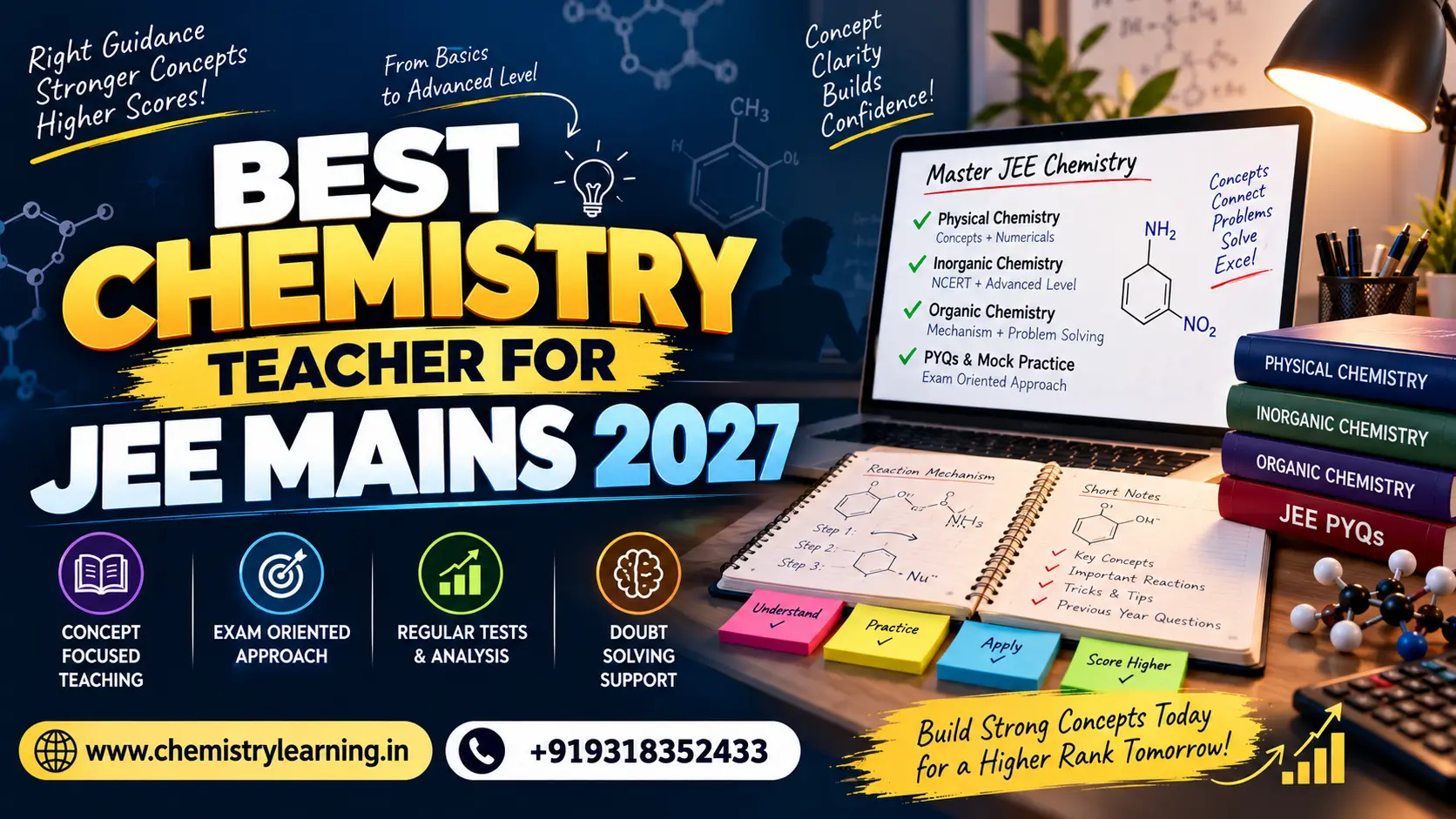
Finding the best chemistry mentor for jee mains 2027 means finding someone who trains speed and understanding together, not one at the expense of the other.
Meet the Mentor Behind the Method
Credentials matter less than track record, and track record is best judged over years, not testimonials. Satyakam Sir has spent over fifteen years teaching chemistry specifically for engineering entrance aspirants, working with students ranging from those comfortably in the top percentile to those who arrived convinced they'd never move fast enough through a numerical-heavy paper. What's kept students returning to recommend him as a top chemistry faculty for jee mains 2027 isn't a marketing campaign — it's the fairly unusual habit of explaining the "why" behind every formula and reaction before ever asking a student to apply it under time pressure.
He's also unusually candid about what teaching JEE Mains Chemistry actually requires: patience with concepts most teachers rush past, paired with a genuine obsession over calculation speed and exam-day time management. That combination — technical depth alongside real, drilled speed — is a large part of why he's regularly named among the people best positioned to be the best chemistry teacher for jee mains 2027 in india by students who've compared multiple coaching options before settling on one.
That reputation isn't built on a single cohort or a lucky batch of toppers. It's built on a consistent pattern, repeated across years and across very different starting points — students who arrived confident in Chemistry but too slow under pressure, and students who arrived intimidated by the sheer size of the syllabus. What both groups tend to report afterward is the same thing: fewer wasted seconds staring at a familiar-but-not-quite-right question, because the teaching had already anticipated exactly how JEE Mains likes to test a concept.
Inside Satyakam Sir's Chemistry Teaching Method for JEE Mains 2027
So what actually happens when you enroll in best chemistry classes for jee mains 2027 built this way? It isn't a handful of extra tips bolted onto the same old teaching. It's a complete shift in how a student's brain is trained to process chemical information under a ticking clock. This is precisely what separates a best chemistry faculty for jee mains 2027 from a merely popular one — Satyakam Sir has spent years refining a system that treats Physical, Organic, and Inorganic Chemistry as three genuinely different disciplines, each demanding its own strategy, not one generic lecture format stretched across all three.
Phase 1: Physical Chemistry, Built for Speed
Physical Chemistry is the most dreaded section for students who assume their mathematical reflexes aren't sharp enough. It looks like physics, calculates like math, and operates on chemical principles underneath. The sheer volume of Numerical Value Questions in the JEE Mains paper makes this a high-stakes, time-sensitive battleground.
The Strategy Toolkit:
- A hard, non-negotiable ban on memorizing formulas you haven't derived yourself.
- Full command over dimensional analysis and unit tracking as a built-in accuracy check.
- Rapid approximation and mental-math shortcuts trained through daily drilling.
- High-pressure numerical sets, timed exactly like the real exam, every single week.
- Derive it, don't memorize it. Whether it's Mole Concept, Thermodynamics, or Electrochemistry, the formula is derived on the board before it's ever used in a problem — so a slightly reworded JEE Mains question doesn't cost precious seconds of hesitation.
- Let units do the thinking for you. If a problem hands you pressure in atmospheres and volume in litres but asks for work in joules, the conversion itself guides you to the correct formula instantly, even on a day when memory briefly falters.
- Train recognition speed relentlessly. JEE Mains rewards students who can identify the correct approach within seconds. Short, regular numerical sets build that instinct deliberately, until solving under thirty seconds per question feels normal rather than rushed.
Why It Works
Working memory is limited. If part of a student's attention is spent second-guessing a half-remembered formula, there's less bandwidth left to actually solve the problem fast. Derivation-first teaching removes that tax entirely, and speed becomes a natural side effect of genuine understanding rather than a separate skill bolted on top.
Phase 2: Organic Chemistry, Decoded
Organic Chemistry produces more lost marks than any other section, mostly because students try to memorize it like a list of historical facts instead of learning it as a predictable, logic-driven system. JEE Mains organic questions tend to be more direct than Advanced's multi-step traps, which means a student with genuine mechanistic clarity can move through this section fast — but only once the underlying logic actually clicks.
The Strategy Toolkit:
- Total command over General Organic Chemistry before advanced chapters are introduced.
- A visual, working sense of electrophiles, nucleophiles, and how they actually interact.
- Sharp, fast instincts for carbocation, carbanion, and free-radical stability.
- Confident, quick handling of 3D stereochemistry, including R/S configuration and optical isomerism.
- GOC comes before everything else. Inductive effect, resonance, hyperconjugation, and electromeric effect are locked in first — skipping this step is the single biggest reason Organic Chemistry starts to feel random and slow later in the syllabus.
- Watch the electrons, not the answer key. Students are trained to trace exactly how a nucleophile finds an electrophile, so an unfamiliar reagent stops being a reason to hesitate and starts being a reason to reason it out quickly.
- Build pattern recognition for direct questions. Since JEE Mains organic questions are usually more straightforward than Advanced's layered traps, students drill enough variety that recognizing the "type" of question becomes near-instant.
Why It Works
Molecules follow strict, predictable rules of electronegativity and steric hindrance. Once a student understands the "personality" of a reagent, genuine scientific intuition replaces hesitation — and intuition is simply faster than reconstruction from a memorized list every single time.
Phase 3: Inorganic Chemistry, Without the Cramming
Inorganic Chemistry is universally underrated by students chasing a fast JEE Mains score, which is precisely the mistake. Most offline teachers simply tell their students to "just read the NCERT and memorize the tables." This is lazy teaching, and it's also slow — a memorized table takes longer to recall accurately than a genuinely understood trend.
The Strategy Toolkit:
- The NCERT textbook, treated as the supreme, unquestionable authority.
- Real command over Quantum Numbers, Shielding Effect, and Effective Nuclear Charge.
- Dedicated, unhurried time on Chemical Bonding — VSEPR, hybridization, and Molecular Orbital Theory.
- Active recall and spaced repetition, instead of a single cramming push before the exam.
- Bonding is the master key. The p-block, d-block, and Coordination Compounds are impossible to answer quickly without a solid grip on how atomic orbitals overlap, so this gets real depth rather than a rushed overview.
- Explain the exceptions. An anomalous ionization trend or unexpected oxidation state gets traced back to shielding and lanthanoid contraction, so it stops being an arbitrary fact to remember and becomes something instantly reconstructable.
- Decode the NCERT like it's being cross-examined. Footnotes, data tables, and buried paragraphs get the same attention as the main text, because that's exactly where JEE Mains sources its fastest, most reliable marks.
Why It Works
Random facts fade from memory quickly and take longer to recall accurately under pressure. Facts attached to a clear reason don't — they become instant, predictable conclusions instead of a table a student has to mentally scroll through during a timed exam.
How JEE Mains Chemistry Differs From JEE Advanced
It's worth being explicit about this, because a lot of preparation advice conflates the two exams as if identical strategy works for both. It doesn't, and understanding the difference is part of what makes a chemistry preparation teacher for jee mains 2027 genuinely useful rather than generic.
JEE Mains Rewards
- Speed and consistent accuracy across a large number of questions
- Direct, NCERT-anchored recall, especially in Inorganic Chemistry
- Fast, confident numerical execution over deep derivation-chasing mid-exam
- Steady performance across multiple sessions in a percentile-based system
JEE Advanced Rewards
- Deep, multi-concept reasoning on fewer, more layered questions
- Comfort with twisted, disguised versions of familiar ideas
- Patience for longer, matrix-match and paragraph-style problems
- Resilience across two separate, demanding papers in one day
The encouraging part is that a genuinely strong Mains-level foundation — built through derivation, not memorization — transfers naturally into Advanced-level depth later, if that's the direction a student's preparation eventually takes. The reverse isn't automatically true: a student trained purely for Advanced-style depth without also drilling Mains-level speed can still lose easily avoidable time on a large, fast-paced Mains paper. That's why the phase-by-phase method above never sacrifices genuine understanding for pure speed — it builds both together, in the order that actually compounds.
Making the Most of Multiple JEE Mains Sessions
Unlike a single-shot exam, JEE Mains typically runs across more than one session, and that structure changes how chemistry preparation should be planned. Treating each session as an isolated, unrelated attempt wastes one of the format's biggest advantages: the ability to learn directly from your own mistakes and walk into the next session measurably stronger.
After a first attempt, a focused review of exactly which Chemistry questions were missed — and why — tends to be far more valuable than a generic "revise everything again" approach. A missed Inorganic question usually points to a specific NCERT gap that can be closed in days. A missed Physical Chemistry numerical often points to a speed or unit-tracking habit that needs targeted drilling, not a full re-study of the chapter. An expert chemistry teacher for jee mains 2027 treats the gap between sessions as a genuine second preparation cycle, not a waiting period.
Why "Chemistry Teacher Near Me" Isn't the Right Question Anymore
There's still a lingering assumption among some parents that online learning is a fallback option — something you settle for if a good offline institute isn't nearby. That assumption made more sense a decade ago. It doesn't hold up as well now, and for a subject like chemistry, it arguably never should have.
Consider what a recorded, well-structured lecture actually offers that a live classroom can't: the ability to pause exactly when a derivation gets dense, rewind a step you missed, and revisit an entire topic three weeks before a test without asking anyone's permission. For a subject built on layered logic, that flexibility isn't a minor convenience — it's often the difference between a concept sticking and a concept being half-understood and quietly forgotten.
Geography is the other piece of it. A student typing "chemistry teacher near me for jee mains 2027" into a search bar is really asking a proximity question when what actually matters is a quality question. A strong chemistry teacher for jee mains 2027 online means the same structured, doubt-supported teaching available to a student in a major coaching hub is available anywhere with a stable internet connection — no relocation, no waitlist, no settling for whoever happens to be nearby.
What matters, though, is that the online format is paired with real interaction, not just pre-recorded content. The best online chemistry teacher for jee mains 2027 setups keep live doubt-clearing, regular testing, and direct feedback intact — the recording is a supplement to the learning, not a replacement for the teaching relationship. There's also a quieter benefit that rarely makes it into marketing copy: consistency. A student attending an offline batch is at the mercy of that day's traffic, that week's substitute teacher, or a chapter rushed through because the syllabus calendar demanded it. A well-run online program removes most of that variability — the same structured teaching, the same testing cadence, and the same doubt-resolution process, week after week.
"I've taught students who walked in convinced they were simply too slow for a paper like JEE Mains. Almost every time, what they actually lacked wasn't speed — it was genuine understanding, which is what speed is built on top of. Fix the understanding, and the speed follows naturally. That's the entire job. Everything else is detail."
— Satyakam Sir
Revision and Mock Tests: Where the Final Marks Get Decided
Teaching alone doesn't finish the job. By the time a student is a few months out from JEE Mains, pure content coverage stops moving the score much on its own — what actually moves it is disciplined revision paired with honest mock test review. A genuine chemistry expert for jee mains 2027 preparation treats this final stretch as its own distinct phase, not an afterthought squeezed in once the syllabus is "done."
Revision here means active recall, not re-reading. Closing the notes and trying to reconstruct a concept from memory before checking what was missed sticks far better than skimming the same paragraph a fourth time. Inorganic Chemistry especially needs this kind of spaced, repeated contact — a chapter revised once every few weeks, in short, focused bursts, holds up far better under exam pressure than the same chapter crammed the night before.
Mock tests, meanwhile, are only as useful as the review that follows them. Taking test after test without categorizing each wrong or guessed answer — was it a genuine concept gap, a careless slip, or a time-pressure decision made in the final seconds of the section — means the same mistakes tend to quietly repeat themselves across sessions without anyone noticing the pattern. A structured program builds that review step directly into the process, rather than leaving it to the student to figure out alone.
Mistakes That Quietly Undermine JEE Mains Chemistry Scores
A few patterns show up often enough among JEE Mains aspirants that they're worth calling out directly. The first is confusing familiarity with mastery — being able to recognize a fact or formula on the page is a very different skill from reconstructing it cold and applying it fast, and JEE Mains is specifically built to expose that gap under time pressure.
The second is treating Organic Chemistry as a memorization exercise instead of a logic one, trying to remember dozens of reaction outcomes independently rather than understanding the handful of mechanisms that generate all of them. The third, and probably the most common, is under-investing in Inorganic Chemistry until the final weeks, simply because it doesn't feel as intellectually demanding as Physical Chemistry numericals — right up until a student realizes, uncomfortably close to the exam, just how much fast, reliable scoring potential was left untapped.
What a Real JEE Mains 2027 Chemistry Program Should Include
Beyond the teaching itself, the day-to-day structure of a program matters more than most students expect going in. A brilliant lecture that isn't followed by testing, doubt resolution, and timed practice tends to fade within weeks. Here's what separates a genuinely useful best chemistry coaching for jee mains 2027 program from a lecture series with a fancy name.
Live, Interactive Sessions
Not just playback — real-time doubt handling built directly into the class itself, not bolted on afterward.
Speed-Focused Numerical Drills
Regular, timed practice specifically designed to build the calculation speed JEE Mains rewards, not just accuracy in isolation.
Chapter-Wise Testing
Weak spots surface early, while there's still time to fix them, instead of showing up in a disappointing session score.
Structured Revision Cycles
Especially for Inorganic Chemistry, which decays fast without a fixed, repeating schedule built in from the start.
This is the practical shape of what a best chemistry tutor for jee mains 2027 and a full best chemistry mentor for jee mains 2027 relationship should look like when you strip away the marketing language — consistent teaching, backed by a system that catches gaps before they become expensive on exam day. Whether you're calling it best chemistry coaching institute for jee mains 2027 or simply looking for the right chemistry preparation teacher for jee mains 2027, this is the standard worth measuring any option against.
None of this works as a shortcut, and it shouldn't. What it offers instead is a straight line between effort and result — the kind of preparation where every hour put in actually compounds, instead of quietly leaking away into facts that get forgotten the moment exam-day nerves and the clock kick in together.
The Real Choice Behind "Best"
Strip away the rankings and the review pages, and choosing among the many people claiming to be the best chemistry teacher for jee mains 2027 really comes down to one practical question: does this teacher's method actually close the specific gap between where a student is now and where they need to be, both in understanding and in speed, on exam day? Everything covered in this guide — the phase-wise methodology, the Mains-versus-Advanced distinction, the multi-session strategy, the online-versus-offline argument — exists to answer that question honestly, rather than to make a broad, unverifiable claim about being "the best" in the abstract.
That's ultimately the standard worth applying to any JEE Mains 2027 chemistry decision, regardless of which mentor or institute a student eventually chooses: not who has the loudest marketing, but whose method demonstrably turns hesitation into fast, confident, correct answers.
Give Your JEE Mains 2027 Chemistry a Real Method, Not Just More Hours
More revision hours don't fix a shaky foundation, and more speed drills won't help if the underlying concepts are still shaky. A structured, concept-first program builds both together. If you're ready to stop guessing and start scoring, this is where that shift begins.
Join Satyakam Sir's JEE Mains 2027 Chemistry ProgramFrequently Asked Questions

About Satyakam Sir
Satyakam Sir has spent over fifteen years teaching chemistry to engineering entrance aspirants, with a teaching philosophy built entirely around explaining the reasoning behind a concept before ever asking a student to apply it at speed. He currently mentors JEE Mains 2027 aspirants through a structured, concept-first online chemistry program.