

Ask any JEE Advanced qualifier what actually separated them from the thousands of students who prepared just as hard, and the answer almost never involves a secret shortcut. It's nearly always some version of the same sentence: "I actually understood what I was doing." That single difference — between recognizing a concept and genuinely understanding it — is what decides more chemistry scores than talent, coaching brand names, or the number of hours logged ever will.
That's the real story behind satyakam sir chemistry teaching, and it's why so many students specifically search for satyakam sir jee chemistry once they realize their preparation has quietly become a pile of memorized facts rather than a working understanding of the subject. It isn't a claim to being the flashiest classroom in the country. It's a claim to being the most honest one — a place where a shaky foundation gets rebuilt properly instead of papered over with more notes.
This piece isn't a highlight reel. It's a genuine walkthrough of how satyakam sir builds strong chemistry fundamentals for jee mains and advanced aspirants — what "strong fundamentals" actually means in a subject this vast, how that foundation gets built phase by phase, and why skipping this step is the single most common reason bright students plateau well below their potential.
Why "Fundamentals" Isn't Just a Buzzword in Chemistry
Every coaching brochure uses the word "fundamentals" somewhere on the page. Almost none of them explain what it actually means in practice, so it's worth being specific. Strong chemistry fundamentals for jee means a student can explain why a concept is true, not just recall that it is. It means being able to rebuild the Nernst equation from scratch instead of hoping it's remembered correctly under pressure. It means recognizing that a JEE Advanced question is really just a familiar concept wearing an unfamiliar disguise, rather than something entirely new.
This matters more in chemistry than almost anywhere else in the JEE syllabus, because chemistry genuinely can be built from the ground up. Unlike some Physics topics that demand raw problem-solving stamina, most of Chemistry follows a strict internal logic — bonding determines structure, structure determines reactivity, reactivity determines outcome. Once that logic is understood, huge portions of the syllabus stop needing to be memorized at all. That's the entire premise behind teaching chemistry from basics for jee mains and advanced instead of jumping straight into problem sets: get the logic right first, and the problems start solving themselves. It's also precisely why students preparing specifically for the Advanced paper tend to seek out a best chemistry teacher for jee advanced rather than settling for generic Mains-only preparation — the twisted, multi-concept questions Advanced is known for simply don't yield to memorization the way a direct Mains question sometimes can.
A Simple Test You Can Run Yourself
Pick any formula you "know" right now. Try to explain, out loud, where it comes from — not what it's used for, where it actually comes from. If you can't, that's not a knowledge gap that will show up on a chapter test. It's one that JEE Advanced is specifically built to find.
The Cost of Skipping the Basics
Across most large coaching setups in India, the pressure to "finish the syllabus" pushes teaching toward speed over depth. A chemistry faculty for jee working against a fixed calendar in a two-hundred-student batch rarely has the luxury of slowing down for a genuinely confused student — the lecture moves on, and the gap quietly gets carried forward into the next chapter, and the one after that.
This is exactly how "weak in chemistry" becomes a permanent identity for students who were never actually incapable — they just never had a topic explained slowly enough, early enough, for the logic to genuinely land. By the time Class 12 arrives and the syllabus doubles in density, that early gap has usually compounded into something far harder to fix. A genuine top chemistry teacher for jee treats this as unacceptable and builds the entire teaching calendar around preventing it in the first place, rather than trying to patch it up in a rushed revision month.
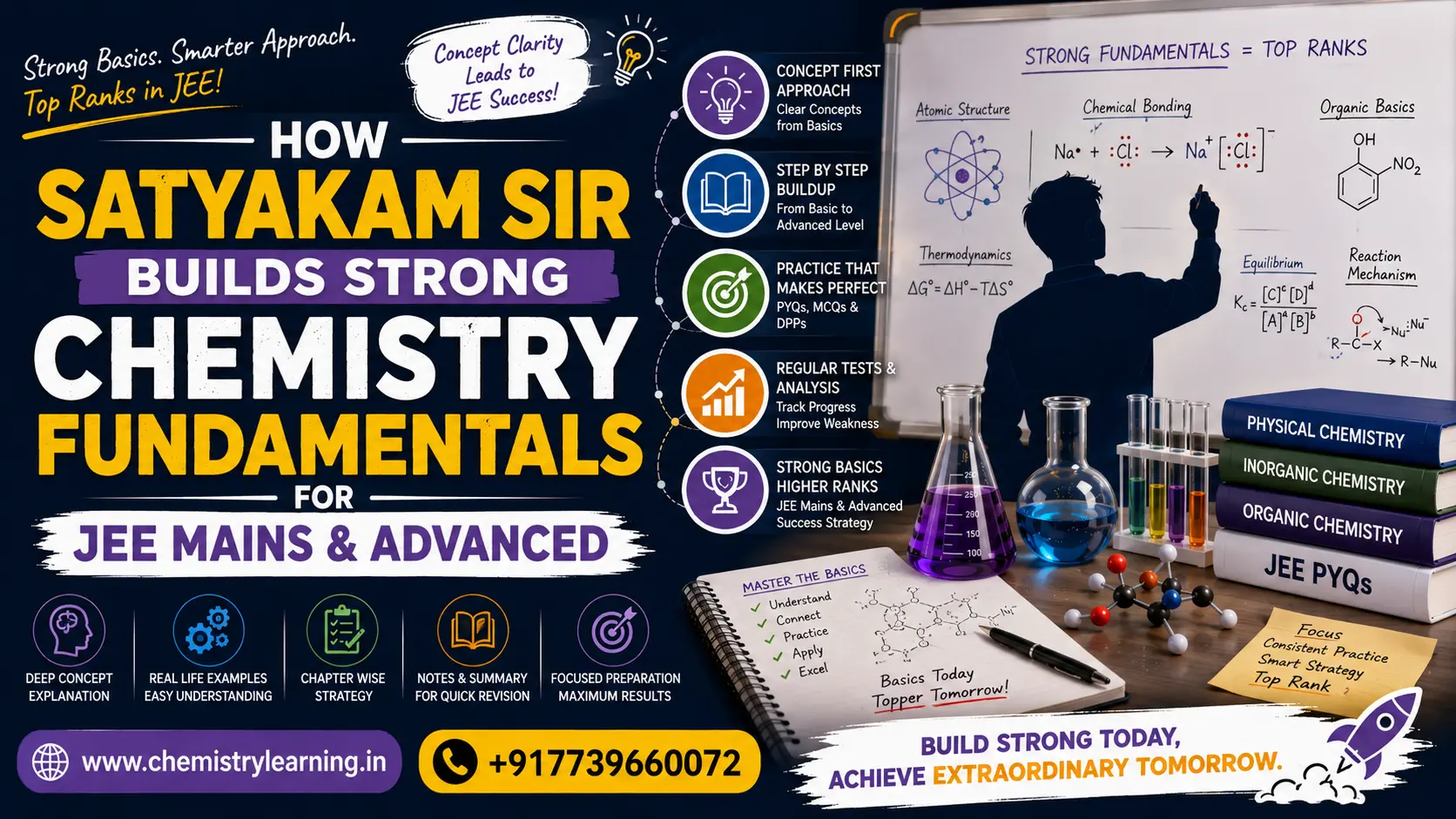
Real concept clarity in chemistry for jee is built slowly, months before it's ever tested under exam pressure.
How to Build Strong Chemistry Concepts for JEE, Phase by Phase
Concept based chemistry for jee isn't a single technique — it's a discipline applied consistently across three genuinely different branches of the subject. Physical Chemistry needs derivation-first teaching. Organic Chemistry needs electron-flow reasoning. Inorganic Chemistry needs a near-forensic relationship with the NCERT text. Here's exactly how how to build strong chemistry concepts for jee plays out across all three, without shortcutting any of them.
Physical Chemistry for JEE Mains and Advanced
Physical Chemistry intimidates students who assume it demands raw mathematical talent. In reality, it demands something more learnable: comfort with derivation and precision with units. Both are trainable skills, not fixed traits.
The Foundation Toolkit:
- A firm rule against using any formula that hasn't been derived and understood first.
- Fluency in dimensional analysis as a built-in accuracy check.
- Rapid estimation techniques for logarithms and approximations, trained daily.
- Numerical sets solved under real time pressure, not untimed comfort.
- Every formula gets rebuilt from scratch. Collision theory, activation energy, and the Boltzmann distribution are taught in full before the Arrhenius equation is ever used in a problem — because a formula you can rebuild is a formula that survives exam-day pressure.
- Units become your safety net. When pressure, volume, and energy show up in mismatched units inside a single problem, students are trained to let the conversion guide them to the correct formula, even if memory briefly fails.
- Speed gets trained separately from accuracy. Once a concept is genuinely understood, timed numerical drills build the raw speed that JEE Mains specifically rewards, without sacrificing the precision JEE Advanced demands.
Why It Works
Working memory is limited. If part of a student's attention is spent second-guessing a half-remembered formula, there's less capacity left to actually solve the problem. Derivation-first teaching removes that tax entirely, freeing up mental bandwidth exactly when it matters most.
Organic Chemistry for JEE Mains and Advanced
Organic Chemistry produces more lost marks than any other section, mostly because students try to memorize it like a list of historical facts instead of learning it as a predictable, logic-driven system. Once the electron-flow logic clicks, the entire section becomes dramatically less intimidating.
The Foundation Toolkit:
- Total command over General Organic Chemistry before advanced chapters are introduced.
- A visual, working sense of electrophiles, nucleophiles, and how they actually interact.
- Sharp instincts for carbocation, carbanion, and free-radical stability.
- Confident handling of 3D stereochemistry, including R/S configuration and optical isomerism.
- GOC comes before everything else. Inductive effect, resonance, hyperconjugation, and electromeric effect are locked in first — skipping this step is the single biggest reason Organic Chemistry starts to feel random later in the syllabus.
- Watch the electrons, not the answer key. Students are trained to trace exactly how a nucleophile finds an electrophile, so an unfamiliar reagent stops being a reason to guess and starts being a reason to reason it out.
- Rearrangements get anticipated, not discovered too late. JEE Advanced loves hiding hydride shifts, methyl shifts, and ring expansions inside multi-step questions — students are trained to pause and check for them automatically before committing to a final answer.
Why It Works
Molecules follow strict, predictable rules of electronegativity and steric hindrance. Once a student understands the "personality" of a reagent — why a bulky base favors Hofmann elimination over Zaitsev, for instance — genuine scientific intuition replaces guesswork, and that intuition transfers to reactions never seen before.
Inorganic Chemistry for JEE Mains and Advanced
Inorganic Chemistry has an unfair reputation as a boring list of exceptions. Taught properly, it's actually one of the most reliable sources of fast, guaranteed marks anywhere in the syllabus — provided the exceptions are explained rather than memorized.
The Foundation Toolkit:
- The NCERT textbook treated as the final, non-negotiable authority.
- Real command over Quantum Numbers, Shielding Effect, and Effective Nuclear Charge.
- Dedicated, unhurried time on Chemical Bonding — VSEPR, hybridization, and Molecular Orbital Theory.
- Active recall and spaced repetition, instead of a single cramming push before the exam.
- Bonding unlocks everything else. The p-block, d-block, and Coordination Compounds are impossible to genuinely understand without a solid grip on how atomic orbitals overlap — so this gets taught in real depth, not skimmed.
- Anomalies get explained, not memorized. An unexpected ionization trend or oxidation state gets traced back to shielding and lanthanoid contraction, so it stops being an arbitrary fact to remember and becomes something the student could have predicted.
- The NCERT gets read like it's being cross-examined. Footnotes, data tables, and buried paragraphs get the same attention as the main text, because that's exactly where NTA sources its toughest Assertion-Reason questions.
Why It Works
The brain struggles to hold onto isolated, disconnected facts but is genuinely good at retaining logical narratives. Once an inorganic "exception" is attached to the physics behind it, it stops being random — it becomes an inevitable, predictable conclusion that's far harder to forget.
Using Chemistry Previous Year Questions the Right Way
Almost every JEE aspirant solves chemistry previous year questions for jee at some point. Very few use them correctly. The common mistake is treating PYQs as a way to "learn" a topic — solving them before the underlying concept is actually solid, which just trains pattern recognition instead of real understanding, and quietly falls apart the moment a question is phrased differently.
The Right Sequence for PYQs
Learn the concept properly first — through derivation, mechanism, or NCERT depending on the branch. Only then bring in previous year questions, and use them for a completely different purpose: to see exactly how the exam likes to disguise that concept. That's the real value of PYQs — not new information, but a clear map of the exam's favorite traps.
Once a chapter's PYQs stop feeling surprising, that's a genuinely reliable signal the concept is exam-ready — far more reliable than simply "feeling confident" about a topic after one read-through.
A Chemistry Preparation Strategy That Actually Holds Up
A sound chemistry preparation strategy for jee isn't a single trick — it's a small number of consistent habits, repeated relentlessly over months. None of these habits are individually dramatic. What makes them work is that they compound: a student who sequences chapters correctly, times their numericals early, revisits Inorganic on a fixed schedule, and actually tracks where marks are being lost ends up with a preparation system that's measurably ahead of one built on effort alone, without necessarily working more hours. Here's what that looks like broken down practically.
Sequence, Don't Rush
GOC before reactions. Bonding before p-block. Mole concept before thermodynamics. Skipping the sequence to "save time" almost always costs more time later.
Time Numericals Early
Don't wait until the final months to practice under time pressure. Speed built early becomes instinct; speed built late stays fragile under exam-day nerves.
Revisit on a Schedule
Inorganic Chemistry especially decays fast without regular contact. A fixed weekly revisit beats a single intense cram every time.
Track, Don't Guess
Chapter-wise testing tells you exactly where marks are actually being lost — guessing at your own weak spots wastes revision time on chapters that were already fine.
Chemistry Roadmap for JEE 2026 and JEE 2027
Where an aspirant currently sits on the calendar changes the roadmap significantly, even though the underlying stages stay the same. A chemistry roadmap for jee 2026 has to compress the foundation phase and move into revision and PYQ practice sooner, simply because the clock doesn't allow for a slow build. A chemistry roadmap for jee 2027 has real room to spend on depth early — and that extra time is wasted if it isn't actually used for it.
Class 11 concepts built slowly and properly — GOC, Mole Concept, and Atomic Structure get the deepest treatment, since everything later depends on them.
Class 12 chapters layered on with deliberate links back to Class 11 material, so the syllabus feels connected rather than like a growing pile of separate topics.
Previous year questions get introduced chapter by chapter, once each concept is solid, to reveal exactly how JEE likes to disguise familiar ideas.
Full-length, timed mock tests take over, with every wrong or guessed answer reviewed closely enough to know exactly what needs fixing.
The stages don't change between a 2026 and a 2027 attempt — only the pace does. A 2027 aspirant might spend the better part of a year in Foundation and Expansion combined. A 2026 aspirant compresses that same ground significantly and reaches PYQ Integration far sooner, because there simply isn't a choice.
A Chemistry Revision Plan That Doesn't Fade by Exam Day
Most students revise by re-reading, and most students are frustrated by how little that actually helps once the exam gets close. A working chemistry revision plan for jee replaces passive re-reading with active recall — closing the notes and trying to reconstruct a concept from memory before checking what was missed, rather than simply skimming the same paragraph a fourth time.
Spaced repetition matters just as much, especially for Inorganic Chemistry, which fades quickly without regular contact. A chapter revisited in short, focused bursts every few weeks sticks far better than the same chapter reread twice in one long session the night before a test.
Common Mistakes That Undermine Strong Fundamentals
Most students working through the JEE syllabus aren't lazy — the effort is usually genuinely there. What quietly undermines strong fundamentals is a handful of habits that feel productive in the moment but don't actually build the kind of understanding the exam rewards.
The first is mistaking familiarity for mastery. Reading a chapter for the third or fourth time feels like real progress, but recognizing a concept on the page is a completely different skill from reconstructing it from memory with the book closed. JEE Advanced is specifically designed to expose this gap, because it rarely asks a question in the exact form it was studied.
The second is rushing through Class 11 fundamentals to "get to the real syllabus" faster. Mole Concept, GOC, and Atomic Structure feel foundational precisely because they are — and a shaky grip on any of them tends to resurface, painfully, somewhere in Class 12 when a more advanced chapter assumes that foundation is already solid.
The third is solving problems without ever reviewing the mistakes properly. Getting a numerical wrong and simply checking the correct answer, without working out exactly where the reasoning broke down, means the same category of mistake tends to repeat itself for months without the student noticing a pattern at all.
A Quick Way to Check Yourself
Take any topic you studied more than a month ago and try teaching it out loud, from memory, as if explaining it to someone else. Where you hesitate or fumble is exactly where your fundamentals need another pass — and it's far better to find that out now than during a JEE Advanced paper.
Why Mock Test Strategy Decides the Final Stretch
In the final months before JEE, pure content revision stops moving the score much on its own. What actually moves it is a disciplined chemistry mock test strategy for jee — not simply taking more tests, but reviewing every wrong or guessed answer closely enough to categorize the mistake. Was it a genuine concept gap? A careless, avoidable error? A time-pressure decision made in the final thirty seconds of a section?
Each category demands a different fix. Concept gaps send a student back to that specific topic for a proper re-look. Careless errors demand slower, more deliberate reading of the question stem. Time-pressure mistakes mean the pacing strategy itself needs adjusting before the next mock. Skipping this review step and simply moving straight to the next test is one of the most common ways strong students plateau right before the exam that matters most.
Personalized, Online, and Built to Fit You
None of this works particularly well delivered identically to two hundred students at once. That's why chemistry coaching for jee mains and advanced under this method leans heavily on chapter-wise testing — not as a formality, but as the actual mechanism that flags an individual student's weak spots early enough to fix them, instead of finding out too late through a disappointing mock score.
It's also why so many students specifically look for a best online chemistry teacher for jee rather than settling for whichever institute happens to be nearby. A recorded, structured lecture that can be paused and revisited during the final revision months does something a single live pass in a crowded classroom simply can't — it hands the pace of learning back to the student. Paired with a real doubt-resolution system and consistent chemistry classes for jee preparation, it becomes a genuine mentorship, not a one-way broadcast.
For a student who's been searching for a reliable chemistry tutor for jee after one too many disappointing chapter tests, this is usually the actual turning point — not a new set of notes, but a teacher willing to slow down until the "why" behind a concept genuinely lands.
A Direct Message from Satyakam Sir
"I've taught students who were convinced they simply weren't 'chemistry people.' In almost every case, the actual problem was that nobody had slowed down long enough to explain the reasoning clearly. Being called a chemistry teacher with best jee results means very little to me on its own — what matters is that a student walks into the exam hall with a foundation strong enough that nothing on that paper can genuinely surprise them. I'm proud to be counted among the top chemistry mentor in india for jee names for exactly that reason, and I intend to keep earning it one derivation at a time."
Build the Foundation That Doesn't Crack Under Pressure
More notes and more hours won't fix a shaky foundation — only rebuilding it properly will. If you're ready to stop memorizing and start actually understanding chemistry, this is where that shift begins.
Join Satyakam Sir's JEE Chemistry ProgramFrequently Asked Questions

About Satyakam Sir
Satyakam Sir has spent over fifteen years teaching chemistry to JEE aspirants, with a teaching philosophy built entirely around explaining the reasoning behind a concept before ever asking a student to apply it. He currently mentors JEE Mains and Advanced aspirants through a structured, concept-first online chemistry program.